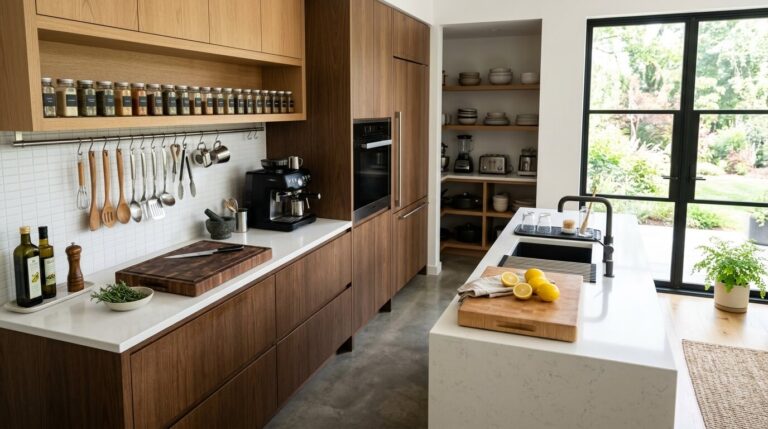

10 Kitchen Counter Ideas That Look Beautiful and Stay Functional
By Amelia Harper | Kitchen and Home Living Writer
The kitchen counter is the surface that does the most work in any home and the one that requires the most thought to keep both beautiful and genuinely useful. Most counter advice lands in one of two places: either it focuses entirely on aesthetics, suggesting arrangements that look stunning in photographs but fall apart the moment someone actually tries to cook, or it focuses entirely on function, producing a surface that is organised but visually cluttered and uninspiring.
The best kitchen counters achieve both simultaneously, and they do so through a specific set of principles rather than through luck or a particularly spacious kitchen. These counters look intentional rather than accumulated. They hold what belongs on the counter and nothing else. And they remain in good visual condition not because the occupant is unusually disciplined but because the system behind them makes the right thing easy.
You don’t need a full renovation to transform your countertops. Explore our guide to small kitchen upgrades with a big impact and discover simple changes that make your space feel more functional and inviting.
I have been writing about kitchen design and organisation for nearly a decade, and the counters that consistently achieve this balance share identifiable characteristics. Here is every idea that works, explained with enough practical detail to be immediately applicable.
1. Start With a Complete Clear-Out and Reset

Before adding anything intentional to the counter, removing everything from it and starting from nothing is the only way to make genuinely considered decisions about what belongs there permanently.
Most kitchen counters accumulate their current contents through a series of small, unconsidered additions rather than through any deliberate arrangement. An appliance appeared after a gift. A small container of utensils grew from two to ten because adding another was always easier than deciding where else it should go. Mail arrived and no one moved it. The result is a counter whose arrangement reflects the path of least resistance rather than any actual intention.
Clearing the counter completely, wiping every surface, and then standing back to look at the clean space before adding anything back provides the psychological reset needed to make deliberate choices. The empty counter communicates the potential of the space rather than the accumulated history of what landed on it.
The return phase should be governed by a single criterion: does this item need to be on the counter to be functional, meaning is it used frequently enough and consistently enough that storing it away would create meaningful friction in daily cooking? Every item that does not meet this criterion belongs somewhere else, regardless of how long it has been on the counter or how convenient it is to have it there.
2. Define Zones and Give Each One a Clear Purpose

A counter with defined zones, where each section of surface has a specific function, looks more organised and is more functional than a counter where items are distributed without a spatial logic that connects their placement to how they are used.
The most common useful zones in a standard kitchen counter arrangement are a coffee and tea station near the kettle or coffee maker, a food preparation zone adjacent to the primary sink, a cooking zone near the stove with immediate access to oils and frequently used utensils, and a small landing zone near the kitchen entrance or the primary traffic path where things that arrive in the kitchen can be placed temporarily before being put away.
Defining these zones physically, by keeping items within each zone together and leaving clear transitions between zones, makes the counter easier to read visually and faster to use functionally. A cook reaching for olive oil knows it is in the cooking zone. A person making morning coffee knows everything needed is in one location rather than distributed across the counter.
The discipline of returning items to their zone after use is what maintains the arrangement over time. A zone-based counter that is used without this return habit drifts back toward a distributed arrangement within days. The habit of returning is easier to maintain when the zones are clearly defined and when every item’s location makes logical sense in relation to where it is used.
3. Use Trays to Group Items and Create Visual Order

A tray is one of the most transformative additions to any kitchen counter because it changes the way a group of items reads visually, converting a collection of separate objects into a single, coherent unit.
A cluster of bottles, oils, vinegars, and salt cellar placed directly on the counter reads as clutter regardless of how neatly they are arranged, because each object is visually separate and the eye processes them individually. The same collection placed on a tray reads as one organised item because the tray creates a defined boundary that contains the group. The eye registers the tray’s outline as a single unit and the individual items within it as its contents.
The practical function of a tray alongside the visual improvement is that it makes cleaning easier. Wiping the counter around a collection of individual items requires moving each one separately. Wiping the counter around a tray requires moving one object, wiping, and replacing. This small practical improvement encourages more frequent wiping and keeps the area under the tray’s items clean rather than accumulating residue.
Choosing a tray that fits the scale and material of the counter helps it feel considered rather than incidental. A wooden tray on a butcher block counter, a marble tray on a stone counter, or a simple ceramic tray on a white laminate counter each reinforce the visual coherence of the counter rather than adding a material that conflicts with it.
4. Limit Appliances to What You Use at Least Three Times Per Week

The appliances on the counter are typically the most space-consuming items and the ones that most quickly tip the balance from organised to cluttered. A strict frequency threshold for counter-worthy appliances produces a dramatically different and more functional result than allowing convenience alone to determine which appliances stay.
The three-times-per-week threshold is a practical standard rather than an arbitrary one. An appliance used three or more times per week is used frequently enough that the overhead of retrieval from cabinet storage begins to accumulate into meaningful lost time over a week, a month, and a year. An appliance used once per week or less does not meet this threshold: the occasional retrieval from storage is a low-friction event for an item that is not needed daily.
For a household that makes coffee every morning, a coffee maker on the counter is clearly justified. For a household that makes smoothies every morning, a blender on the counter is justified. An air fryer used once or twice per week and a bread maker used once per month do not meet the threshold and should occupy cabinet space rather than counter space.
This evaluation is not permanent and can be revisited seasonally. An appliance that earns counter space during summer smoothie season may not need it in winter. Rethinking the counter-versus-cabinet decision for each appliance every few months keeps the counter appropriate for current habits rather than frozen at a past arrangement.
The way you organize your countertops has a big impact on how spacious your kitchen feels. Read our guide to simple ideas that make any kitchen feel bigger and discover easy design tricks that create a more open, airy space.
5. Choose a Consistent Material Palette for Counter Items

The visual coherence of a kitchen counter is strongly influenced by the material and colour consistency of the objects on it, and a counter where items are chosen with the existing palette in mind looks intentional while one where items were added without material consideration looks accumulated even when it is equally organised.
A counter where the oil bottle is dark glass, the salt cellar is white ceramic, the wooden cutting board is natural wood, and the utensil holder is brushed stainless steel has four different materials competing for visual attention in a small space. A counter where the oil bottle is ceramic, the salt cellar is ceramic, the utensil holder is a ceramic crock, and the cutting board is the only wood element has a clear material palette that reads as a considered arrangement.
This principle does not require all items to match perfectly, which would produce a sterile rather than beautiful counter. It requires that the dominant material of the counter items is consistent, with one or two accent materials providing visual interest. A counter primarily in ceramic with wood accents and a single stainless steel element has a clear hierarchy that reads as designed rather than assembled.
When adding a new item to the counter, considering which existing items it will be near and whether its material and colour reinforce or disrupt the existing palette is the habit that builds and maintains visual coherence over time without requiring any single large organisational effort.
6. Keep One Section of Counter Completely Clear at All Times

The clearest visual element of any beautiful kitchen counter is the presence of genuinely empty space, and preserving one section of counter as permanently clear is the single most impactful visual decision available.
Empty counter space reads as luxury, spaciousness, and intentionality. It signals that the kitchen is organised enough that not every inch is needed for storage or display. It provides the visual breathing room that makes adjacent arranged items read as placed rather than crowded. And it provides the functional workspace that transforms a counter from a storage surface into a working surface.
The section to keep clear should be the section most adjacent to the primary food preparation area, typically the section nearest the sink and cutting board area. This positioning ensures the clear space serves the functional purpose of preparation workspace rather than simply being an empty section of counter at an out-of-the-way end.
Maintaining this clear section requires the active habit of returning items to their designated locations after use rather than setting them down on the clear section for later. The clear section should be treated as intentionally clear rather than accidentally clear, which means resisting the natural tendency to let it accumulate mail, bags, and temporarily placed objects over the course of a day.
7. Use Vertical Space Above the Counter Intelligently

The space above the counter between the counter surface and the underside of upper cabinets, or open wall space in kitchens without upper cabinets, is one of the most underutilised dimensions in kitchen organisation and offers the opportunity to move items off the counter surface without losing access to them.
Under-cabinet hooks mounted on the underside of upper cabinets hold mugs, utensils, and small tools at a reachable height without using any counter space. A magnetic knife strip mounted on the wall keeps knives immediately accessible and visible without the counter footprint of a knife block. A mounted paper towel holder removes the paper towel roll from the counter surface. Each of these vertical storage decisions returns a meaningful amount of counter space to the available workspace.
Small shelves mounted between the counter and the bottom of upper cabinets provide surfaces for frequently used items like spice jars, small plants, and lightweight appliances that do not need to occupy the main counter surface. These interim shelves create a visual layer that adds depth to the counter area while reducing the density of items on the primary surface.
The key to maintaining visual beauty while using vertical space is keeping the mounted or shelved items as consistently curated as the counter items themselves. A magnetic knife strip holding five well-maintained knives looks intentional. The same strip with four knives, two vegetable peelers, and a random kitchen tool that has no better home looks like an overflow storage solution rather than a design decision.
A beautiful countertop is much easier to maintain when it’s free of everyday clutter. Explore our guide to the habits that keep kitchens looking clean and learn simple routines that help your space stay fresh and organized.
8. Add One Living Element to the Counter

A living element, whether a small potted herb, a plant cutting in a vessel of water, or a small flower arrangement from the garden, introduces the quality that distinguishes a kitchen that feels genuinely inhabited from one that looks like a showroom.
The psychological effect of a living element in a kitchen environment is well documented in design and environmental psychology research. Living plants and fresh flowers make enclosed spaces feel more connected to the outside world, introduce a quality of natural variation and imperfection that makes the space feel warm rather than sterile, and provide a focal point that draws the eye pleasantly rather than toward the appliances and tools that might otherwise dominate the visual field.
For kitchen counters specifically, a small pot of basil, mint, or rosemary serves a dual function as both a living visual element and a functional herb source. A single stem in a simple vessel provides the living quality without the maintenance demand of a plant. A small bunch of herbs tied with string provides the same effect temporarily.
The placement of the living element matters as much as the choice of the element itself. Positioning it in a natural viewing position, typically near the primary sight line from the kitchen entrance or from the position where cooking happens, makes it a genuine focal point rather than an afterthought at the end of the counter.
9. Address the Corner Problem Specifically

Counter corners are one of the most consistently poorly used areas in kitchens of all sizes. The corner itself is the least accessible section of the counter, requiring a stretch or awkward reach to access anything placed at the very back of it, and it is consequently the area that accumulates the most random items in most kitchens.
A corner counter area that is functioning well is doing one of four things: it is home to an appliance that is large enough to fill the corner footprint effectively, such as a stand mixer that benefits from being in the corner and whose controls face outward into the accessible counter area; it is being used for a dedicated and curated display, such as a small collection of cookbooks in a standing arrangement; it is fitted with a lazy Susan or rotating organiser that makes the back of the corner accessible; or it is intentionally left clear as an extension of the workspace.
Allowing the corner to become an accumulation zone for miscellaneous items, which is what happens in most kitchens without a deliberate decision about how the corner is used, produces a visual weight at the back of the counter that affects the perception of the whole surface.
Addressing the corner with a specific decision about its function, and then maintaining that function with the same intention applied to the rest of the counter, converts the corner from a visual liability into a visual asset.
10. Edit the Counter Seasonally

The kitchen counter that looks and functions best year round is one that is revisited and edited at regular intervals rather than set once and left unchanged.
Seasonal editing recognises that the items that belong on the counter in different seasons genuinely differ. Summer months might call for a blender or juicer occupying prominent position for daily smoothies, while winter might justify a slow cooker being more accessible. A container of fresh herbs in summer serves a function that a sprig of dried rosemary in winter does not replace entirely. The counter that was set up in spring may not serve autumn cooking habits as well as one arranged with autumn in mind.
The seasonal edit does not need to be a comprehensive reorganisation. It is a ten to fifteen minute walk around the counter to evaluate which items are earning their position and which have become habitually present rather than actively useful. An appliance that has not been used in three weeks is not earning its counter space in the current season regardless of how useful it was in the previous one.
Building the seasonal edit into an existing routine, such as the change of seasons itself or the beginning of each month, ensures it happens regularly without requiring a specific scheduling decision each time.
The right countertop setup starts with choosing practical essentials that earn their place. Explore our guide to must-have kitchen essentials for everyday use and discover items that improve both function and style.
The Counter That Works in Real Life
Looking across all the ideas in this article, the pattern that separates counters that maintain their beauty and function over time from ones that deteriorate within weeks is whether the arrangement was built around how the kitchen is actually used or around how it might look in an ideal scenario.
The beautiful kitchen counter is not a static achievement. It is the ongoing result of small, consistent habits applied to a thoughtful initial arrangement. The arrangement determines what goes where. The habits determine whether it stays there. Both are required and neither alone is sufficient.
The counter that looks beautiful every day is not managed by someone with unusual discipline or a particularly large kitchen. It is managed by someone who has understood which items genuinely belong there, arranged them with visual intention, and built the daily habits that maintain the arrangement with minimal ongoing effort.
FAQs About Kitchen Counter Organisation and Design
Clutter perception comes primarily from having too many separate individual items rather than from having too many items overall. Grouping items on trays, limiting the total number of distinct objects on the counter, and maintaining at least one completely clear section changes how the counter reads visually without necessarily reducing the total number of items on it.
A knife block on the counter is justified if knives are used daily and the block is maintained as a tidy, curated item containing only knives in regular use. A magnetic wall strip mounted at the counter backsplash achieves the same accessibility with no counter footprint and is the better solution when counter space is a priority over storage capacity.
The best tray material is the one that reinforces the existing material palette of the counter and kitchen. Wooden trays work in natural and warm kitchen aesthetics. Marble or stone trays work in contemporary and classic kitchens. Ceramic trays work almost universally. The tray should be simple in design and proportional to the group of items it will contain.
A clean, dry cloth kept within reach of the primary counter area allows immediate wiping of spills and residue before they dry. Wiping the counter surface as a reflex immediately after preparing food, before moving to the next task, prevents the accumulation of residue that makes periodic deeper cleaning necessary.
Open shelves above the counter increase the visual complexity of the counter area, which can enhance warmth and personality when styled well or contribute to a cluttered feeling when not curated carefully. Closed cabinets provide a cleaner visual backdrop that makes the counter surface below feel more spacious. The choice depends more on the discipline of curation available than on which is inherently better.
The perception of counter size is primarily determined by how much of the surface is clear rather than by the actual dimensions. A small counter with one clear section looks larger than a larger counter covered entirely with items. Light-coloured counter materials reflect more light and contribute to a sense of spaciousness. Keeping items at the back of the counter rather than at the front preserves the visual depth of the surface.
There is no universal number, because the appropriate quantity depends on the counter’s size, the scale of individual items, and the visual weight of each object. A useful practical test is the ten-second impression test: step back, look at the counter for ten seconds, and note your first impression. If the first impression is busy or cluttered rather than organised or intentional, the counter has more than it should regardless of the specific count.