
10 Beautiful Coffee Station Ideas for Small Spaces (That Actually Work Every Morning)
By Amelia Harper | Kitchen and Home Living Writer
There is something genuinely satisfying about a well-organised coffee station. Not just visually, though that matters, but functionally. The kind of morning where everything you need is exactly where you expect it, where the ritual of making coffee feels smooth and unhurried rather than a search operation through mismatched cabinets, is the kind of morning that sets the right tone for the day.
The difficulty in small kitchens and apartments is that the coffee station often ends up as an afterthought, a coffee maker shoved into whatever counter space is available with the mugs somewhere over there and the coffee in a different cabinet entirely. The intention is always to organise it properly later. Later tends not to arrive.
I have been writing about kitchen organisation and home design for nearly a decade, and the coffee station is one of the subjects I find genuinely enjoyable because the solutions available for small spaces are more creative and more achievable than most people realise. A beautiful, functional coffee corner does not require significant counter space, a large budget, or a renovation. It requires intention, a few specific decisions, and the right ideas.
Here is everything that works.
1. Define the Station’s Footprint Before Choosing Anything Else

The single most important decision in creating a coffee station for a small space is determining its exact footprint before purchasing any organisational elements or making any changes.
A coffee station without a defined boundary expands to fill whatever space is available and adjacent, gradually absorbing the surrounding counter area as additional items find their way into the coffee zone. A coffee station with clearly defined edges, even if those edges are simply the width of the coffee maker plus eight inches on either side, maintains its footprint over time because the boundary is explicit.
Measuring the available space before choosing a tray, cart, or shelf ensures that whatever organisational element anchors the station fits correctly rather than being too large for the space or too small to contain what needs to be there. A tray that is two inches too wide forces a compromise every morning. A tray that is sized correctly to the space feels permanent and intentional.
The footprint decision also includes the vertical dimension. A station positioned under a cabinet has a fixed height constraint. A station on an open wall section can incorporate floating shelves that extend the effective storage area upward without expanding the counter footprint. Knowing the vertical constraint before planning prevents choosing a solution that does not physically fit.
A beautiful coffee station deserves coffee that tastes just as good. If your morning brew has an unpleasant bite, check out our guide on what causes coffee to taste bitter and how to fix it for simple tips that improve every cup.
2. Use a Tray as the Visual and Physical Anchor

A tray is the foundational element of any small-space coffee station because it performs three functions simultaneously: it defines the station’s boundary, it creates visual order by grouping individual items into a single unit, and it makes the entire station movable when the counter needs to be cleared.
The tray should be large enough to contain the items that belong in the station, which for most coffee stations means the coffee maker, a small container for sweetener, and a vessel for stirring spoons or a small ramekin for sugar cubes, while leaving the coffee maker enough clearance to open fully. A tray that is too small creates the problem of items falling off the edge. A tray appropriately sized to the station contains everything cleanly.
The material of the tray contributes significantly to the aesthetic of the station. A wooden tray introduces warmth and a natural quality that pairs beautifully with the browns of coffee and the cream of mugs. A marble or stone tray introduces a luxury quality that elevates even modest appliances. A woven tray introduces texture. Each of these choices communicates something specific about the station’s character.
Trays with raised edges or lips are preferable to completely flat trays for coffee station use because the lip prevents items from sliding off when the tray is repositioned and provides a visual containment that makes the grouped items read as a more complete unit.
3. Mount Floating Shelves Above the Station for Mug Storage

Moving mug storage off the counter and onto a wall-mounted floating shelf above the station is one of the highest-return small space decisions available, recovering significant counter space while simultaneously creating one of the most visually appealing elements of a well-designed coffee corner.
A row of mugs displayed on a floating shelf above the coffee maker, chosen with some degree of visual consistency, reads as a deliberate display rather than overflow storage. The mugs are visible, accessible, and part of the station’s aesthetic. They are at arm’s reach for morning use and return to their exact position after washing. The shelf earns its wall space not just as storage but as a visual element that gives the station height and presence.
The shelf should be mounted at a height that allows comfortable reaching for the tallest person who regularly makes coffee, typically twelve to eighteen inches above the counter level, and positioned directly above the coffee maker or the station’s primary zone rather than offset to the side. A shelf that requires reaching across the appliance to access mugs is awkward in the long term.
The depth of the shelf matters for mug stability. A shelf four to five inches deep accommodates most standard mug bases without the mugs overhanging. A shelf six to eight inches deep accommodates larger mugs and leaves room for a small trailing plant or a few other small objects alongside the mugs.
4. Use the Inside of Cabinet Doors for Hidden Storage

The inside surface of a cabinet door immediately above or adjacent to the coffee station is one of the most underutilised storage locations in any kitchen, and fitting it with an appropriate organiser converts unusable dead space into accessible hidden storage.
Door-mounted racks and organisers can hold individual coffee pods, small packets of sweetener, stir sticks, and tea bags in a location that is hidden when the cabinet is closed and immediately accessible when it is open. For a coffee station in a rented apartment or small kitchen where wall mounting may not be feasible, the inside of a cabinet door provides storage expansion without requiring any permanent installation beyond the adhesive or small screws that mount the organiser to the door interior.
The most useful door-mounted coffee storage is a clear pocket organiser or a small rack with labelled sections for each type of item. Visibility into the storage reduces the searching that disorganised storage requires, and labelling prevents the gradual drift where items migrate out of their designated sections and the organisation collapses.
A door-mounted mug hook system, where a horizontal bar with hooks is mounted inside the door, allows mugs to be stored inside the cabinet when the station is not in use, which is useful for truly minimal countertop situations where even a floating shelf above the station is not feasible.
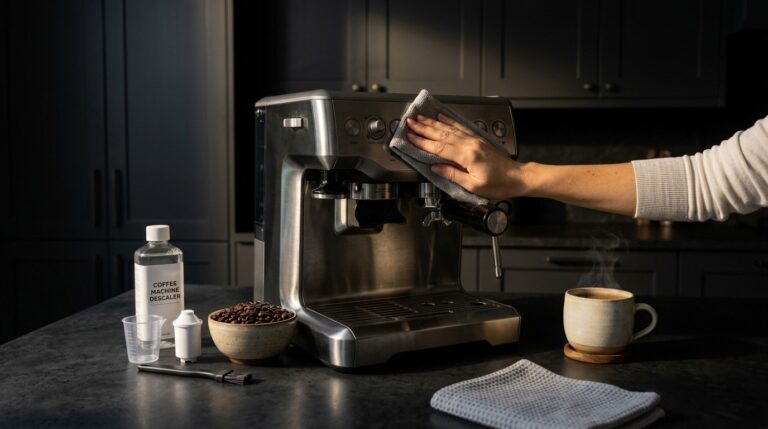
A stylish coffee station also works best when your equipment is well maintained. Learn how to tell when your coffee maker needs cleaning so every cup tastes fresh and your machine stays in great condition.
5. Create a Vertical Station Using a Small Cart or Shelf Unit

A rolling cart or narrow shelf unit placed adjacent to or in the corner beside the kitchen counter converts a vertical floor-to-ceiling space that is otherwise unused into a complete coffee station with multiple levels of organised storage.
A cart with two to three shelves provides space for the coffee maker on the top level, mugs and coffee supplies on the middle level, and a small basket for additional items on the lower level, all within a footprint of approximately twelve to eighteen inches by twenty-four inches. In a kitchen where counter space is the binding constraint but floor space is available in a corner or along a wall, this vertical organisation converts floor space into functional storage more efficiently than any counter-based solution.
Rolling casters on the cart allow it to be positioned at the counter for use during morning coffee and rolled slightly to the side during cooking sessions when that particular corner of the kitchen is needed for preparation. This flexibility is the key practical advantage of a cart over fixed shelving for spaces that need to serve multiple functions at different times.
The visual appeal of a coffee cart comes from its styling rather than the cart structure itself, which is typically utilitarian. A cart that holds a beautifully designed coffee maker, mugs with visual consistency, a small plant, and clearly labelled coffee storage looks like a designed element of the kitchen rather than overflow storage.
6. Organise Coffee Supplies in Matching Containers

The containers that hold coffee, sweeteners, and related supplies contribute as much to the visual quality of the station as the appliances and mugs, and moving from original packaging to consistent containers is one of the most impactful aesthetic improvements available.
Original packaging, foil coffee bags, plastic sweetener bags, and commercial sugar dispensers, communicates commerciality rather than intention. It signals that the station is a collection of purchased items rather than a considered arrangement. Consistent containers communicate that someone has thought about this space and made deliberate choices.
Airtight canisters in a consistent material and colour, whether ceramic, glass, or brushed stainless steel, store coffee more effectively than original bags after opening, provide a clean visual surface that reinforces the station’s aesthetic, and create the opportunity for simple labelling that makes identifying the contents effortless.
The labelling of containers is a detail that seems minor and is more impactful than expected. Handwritten labels on kraft paper tags, or clean printed labels with a consistent font, convert a row of similar containers from an ambiguous collection into a clearly organised system. The labelling also maintains the organisation over time by making each container’s function explicit.
7. Position the Station Near the Kitchen’s Natural Morning Flow

The location of the coffee station within the kitchen affects how well it functions every morning, and positioning it in alignment with the natural movement path of a morning kitchen routine reduces the friction of coffee-making to a minimum.
The natural morning flow in most kitchens moves from the refrigerator, for milk or creamer, to the sink, for water, to the coffee maker, and then to the seating area. A coffee station positioned near the sink, where the coffee maker is filled, and between the refrigerator and the kitchen exit, minimises the number of counter-crossing movements a morning coffee requires.
In a small kitchen where positioning options are limited by the existing layout of appliances and cabinets, even a small positioning optimisation, such as moving the coffee maker from the far end of the counter to the end nearest the sink and refrigerator, produces a morning routine that feels noticeably smoother without any other change.
The station should also be positioned away from the primary cooking area where it will not be displaced or disturbed during cooking sessions. A coffee station adjacent to the stove or directly in the main preparation zone gets moved frequently to make space, which disrupts its organisation and reduces the likelihood that items are returned to their correct positions.
8. Incorporate a Small Drawer or Box for Pod and Accessory Storage

A single small drawer or decorative box integrated into the coffee station provides enclosed storage for items that are functional but not visually attractive, keeping them accessible without having them visible on the station surface.
Coffee pods are one of the clearest examples of items that are functionally necessary at the station but visually distracting when displayed openly. A box or small drawer that holds pods in an organised arrangement, sorted by type or flavour if there are multiple varieties, keeps them at hand without the commercial packaging dominating the station’s visual surface.
The drawer or box also holds the small accessories that accumulate around coffee making: a reusable stir spoon, a small measuring spoon for ground coffee, a cleaning brush for the machine, and any other small tools that are needed regularly but that should not occupy surface space. Having these items in a designated enclosed location prevents them from migrating across the counter.
The material of the storage box should reinforce the station’s aesthetic in the same way the tray does. A wooden box alongside a wooden tray creates material consistency. A ceramic container maintains the clean lines of a ceramic-focused station. The box’s appearance on the outside matters more than its organisation on the inside, because the outside is what is seen when the box is closed.
A well-designed coffee station isn’t just about looks—it also makes it easier to care for your equipment. Explore our guide to simple ways to extend your coffee maker’s lifespan and keep your machine brewing reliably for years.
9. Add a Small Plant or Fresh Flower Element

A living element at the coffee station performs the same function it performs on any kitchen counter: it introduces warmth, naturalness, and the kind of detail that makes the difference between a counter that looks beautiful in a magazine and one that looks beautiful in a real kitchen.
For a coffee station specifically, a small trailing plant like a pothos or heartleaf philodendron, positioned at the corner of the station where it can drape slightly over the edge of the shelf, adds movement and life without taking any functional space from the surface. A small succulent in a ceramic pot the size of a coffee mug adds the living element with almost no footprint and minimal maintenance.
Fresh flowers from the garden or a small weekly market bunch in a narrow bud vase change the station weekly rather than remaining static, which keeps the station looking fresh rather than arranged-and-forgotten. A single stem in a slim vase takes the footprint of a pen and contributes a freshness that no permanent arrangement can replicate.
The living element should be positioned at a point in the station’s visual layout where it does not block access to the coffee maker controls or the mug area. The back corner of the tray, the end of the floating shelf, or the space beside the coffee maker between it and the wall are typically the locations that add the living element without reducing functional access.
10. Use Vertical Wall Space With a Pegboard Section

A small section of pegboard mounted on the wall beside or behind the coffee station converts vertical wall space into flexible, rearrangeable storage for mugs, small tools, and accessories without requiring fixed shelving or cabinet installation.
Pegboard accepts hooks, small shelves, bins, and rails in configurations that can be changed at any time without tools. A mug hook arrangement on pegboard can become a shelf arrangement when the mugs move to a floating shelf, or can be expanded to include a small rail for paper filters or a bin for pod storage as the station’s needs evolve. This adaptability is the primary advantage of pegboard over fixed shelf installations.
Painted pegboard, in the same colour as the wall or in a contrasting accent colour, integrates into the kitchen aesthetic more smoothly than raw wood-coloured pegboard. A section of white pegboard on a white wall effectively disappears visually except for the items hung from it. A section of dark painted pegboard on a lighter wall creates a defined zone that frames the coffee station below.
The section of pegboard does not need to be large to be functional. A section thirty by thirty centimetres provides enough hook and bin positions to meaningfully expand the station’s storage capacity while occupying a wall area that most kitchens have available immediately adjacent to counter-mounted appliances.
The Morning That the Station Makes Possible
A coffee station that is beautiful and functional does not just improve the aesthetic of a kitchen. It changes the quality of the morning routine in a small but genuine way, converting what can be a disorganised search through kitchen cabinets into a smooth, pleasant ritual where everything is where it should be and the act of making coffee is the most effortless part of starting the day.
This outcome is not the product of a large budget or a large kitchen. It is the product of the specific decisions described in this article applied to whatever space is available. The ideas scale to every kitchen size, every counter depth, and every budget level.
The beautiful coffee station in a small space is entirely achievable. It requires intention more than space, and the right organisational decisions more than expensive equipment.
A beautiful coffee station creates the perfect brewing experience, but great flavor comes from the right techniques too. Read our guide on how to make coffee taste more like your favorite café and enjoy better coffee at home.
FAQs About Small-Space Coffee Stations
A functional coffee station can be created in as little as eighteen to twenty-four inches of counter width if vertical storage, including floating shelves and cabinet door organisation, is incorporated. The counter footprint is primarily determined by the coffee maker’s base dimensions, with twelve inches of additional space on one side for mugs and supplies being the practical minimum.
Yes. A narrow rolling cart positioned on the floor beside the counter creates a complete coffee station with its own surface area independent of the main counter. A wall-mounted fold-down shelf provides a surface that can be folded flat when not in use. Both options create functional coffee stations in kitchens where no counter space is available for a dedicated station.
Clear labelling of all containers and designated positions for every item makes the shared station self-organising, because each user can identify where things belong without requiring the system to be explained each time. A brief agreed protocol about returning mugs to the shelf and coffee to its canister after each use maintains the arrangement regardless of who used it last.
The primary driver of clutter perception in a coffee station is the number of separate visible objects. Grouping items on a tray, storing pods and accessories in an enclosed box or drawer, and mounting mugs on a shelf rather than leaving them on the counter surface all reduce the number of separately visible objects significantly without reducing the functional capacity of the station.
Matching all appliances to a single finish, such as all stainless steel or all matte black, creates a strong visual consistency. However, a coffee maker that contrasts intentionally with other appliances, such as a coloured statement coffee maker in a neutral kitchen, can serve as a deliberate focal point rather than appearing mismatched. The distinction between deliberate contrast and accidental mismatch is consistency of intention.
Airtight containers that prevent oxygen, light, and moisture from reaching the coffee preserve freshness most effectively. Opaque or tinted glass containers are preferable to clear glass for coffee storage because light accelerates oxidation. Stainless steel airtight canisters provide the best combination of airtight sealing, light protection, and aesthetic appeal for a visible coffee station.
A rolling bar cart, a converted narrow bookshelf, a floating wall shelf with a fold-down surface, or a small side table near an electrical outlet can all serve as coffee station platforms in a studio apartment. The organisational principles are identical to a kitchen coffee station. The difference is the platform rather than the approach.