
Small Kitchen Storage Ideas for Renters: No-Drill Solutions That Actually Work
By Amelia Harper | Kitchen and Home Living Writer
Renting a small kitchen presents a specific and frustrating challenge that homeowners rarely encounter: you cannot change the kitchen to fit your needs because the kitchen does not belong to you. No drilling holes, no mounting shelves, no installing hooks or rails that would leave marks behind. The walls, cabinets, and fixtures must be returned in the condition they were received, which rules out the majority of kitchen storage solutions that home improvement guides recommend.
The result for most renters is a kitchen that is perpetually under-organised, where the storage space available simply does not match the tools, appliances, and ingredients that need to be stored, and where the solution is constantly compromising between having what you need accessible and keeping the space liveable.
What most renters do not realise is that the no-drill constraint, while genuinely limiting, excludes far fewer effective storage solutions than it appears to. The category of genuinely useful, damage-free storage additions for small rented kitchens is larger than most people know, and the solutions are more capable than the adhesive hooks and tension rods that most people think of first.
I have been writing about kitchen organisation for nearly a decade, and small-space renter storage is one of the subjects I find myself returning to most often because the creative constraint of no permanent modifications produces some of the most genuinely clever solutions available.
Even in a small rental kitchen, the little details can make a surprisingly big impression. Discover the small kitchen touches guests tend to notice and learn how simple styling choices can make your space feel more polished and inviting.
1. Tension Rods Are More Versatile Than Most Renters Realise

The tension rod is one of the most underutilised no-drill storage tools available to renters, and its value extends well beyond the curtain-hanging function most people associate with it.
A tension rod installed vertically inside a cabinet creates an instant divider that keeps cutting boards, baking sheets, and serving trays upright and separated rather than piled flat in an unstable stack. A single cabinet with two or three vertical tension rod dividers can organise flat items that previously required significant stacking and retrieval effort into a tidy, immediately accessible arrangement. Each board or tray slides in and out individually without disturbing the others.
A tension rod installed horizontally under the kitchen sink, positioned mid-height inside the cabinet, creates an instant second shelf in a space that is typically one unusable tall zone. Cleaning spray bottles can be hung by their trigger handles over the rod, which frees the floor of the under-sink cabinet for other items. A second tension rod beside the first doubles the hanging space.
A tension rod installed inside a cabinet door opening, from jamb to jamb at a height that allows items to hang from it, creates a storage rail for small items like measuring cups, a vegetable peeler, or a small colander. The door becomes an additional storage surface without any drilling or permanent modification.
2. Command Hooks and Strips for Walls and Surfaces

Removable adhesive hooks and strips, specifically the Command brand format that removes cleanly from surfaces without damage when correctly applied, are the most important single category of no-drill storage addition for a rented kitchen.
Applied to smooth surfaces including painted walls, tile, cabinet interiors, and the sides of appliances and cabinet exteriors, Command hooks hold a surprisingly wide range of weights when the correct hook size and the manufacturer’s application instructions are followed precisely. The correct application includes cleaning the surface with isopropyl alcohol before applying, pressing firmly for thirty seconds, and waiting the specified curing time before loading the hook.
Command hooks on the inside of cabinet doors hold pot lids, small cutting boards, and lightweight utensils in a location that is immediately accessible when the cabinet is opened but completely invisible when it is closed. A row of Command hooks on the side of a cabinet that faces an open area of the kitchen holds frequently used tools at arm’s reach without occupying any counter or drawer space.
Command strips, the flat adhesive mounting strips rather than hooks, hold lightweight items including spice jars with flat backs, small organiser baskets, and decorative items on wall and cabinet surfaces. The most important usage rule for both hooks and strips is to stay well below the stated weight limit, typically at fifty to sixty percent of the maximum, which significantly extends both the holding reliability and the clean removal when the renter moves.
3. Over-the-Cabinet-Door Organisers for Instant Storage

Over-the-cabinet-door organisers that hook over the top edge of a cabinet door, without requiring any drilling or adhesive, add a full storage surface to every cabinet door in the kitchen and are one of the most high-return no-drill additions available.
These organisers work by hooking over the top edge of the cabinet door and hanging down the interior face of the door. The weight of the organiser and its contents is supported by the cabinet door itself and the door’s hinges rather than by any attachment to the door surface, which means no damage is possible and removal is a simple lift-and-unhook.
An over-door organiser on the cabinet under the sink provides storage for cleaning supplies, rubbish bags, and similar items that currently occupy the cabinet floor. An over-door organiser on a pantry cabinet stores small packages, condiment sachets, and other items that are too small to store efficiently on shelves.
An over-door organiser on a kitchen cabinet door stores spices, small oils, and frequently used ingredients in an immediately visible and accessible position.
The capacity these organisers add is genuinely significant in a small kitchen. A kitchen with eight cabinet doors that each receive an over-door organiser has effectively added eight additional storage surfaces without a single hole in any surface.
Smart storage is easier when every item has a purpose. Explore our guide to essential kitchen items worth making room for and discover practical must-haves that can make a small kitchen more functional.
4. Stackable Shelf Risers Inside Cabinets

A stackable shelf riser placed inside an existing cabinet doubles the effective usable area of that shelf by creating an elevated level above the base items, allowing a second layer of items to be stored above the first without the instability of stacking items directly on each other.
Standard kitchen cabinets have shelf spacing that is designed for a generic range of item heights, which means most shelves have significant wasted vertical space above the items stored on them. A shelf riser placed on the cabinet base or on an existing shelf fills this wasted vertical space with a second accessible level, effectively converting one shelf into two.
Shelf risers are available in multiple heights and widths to accommodate different cabinet dimensions and different item height combinations. A riser six inches tall placed on a shelf below canned goods, for example, creates a second level that can hold condiment bottles, while the cans stored on the main shelf level are still fully accessible by reaching over or around the riser.
The most useful shelf riser configurations for small kitchens are inside the pantry cabinet where goods of different heights need to coexist efficiently, inside the cabinet where plates and bowls are stored where the riser creates a plate storage level and a bowl storage level within the same shelf space, and inside the medicine-style cabinet over the sink where the additional level organises small items that otherwise pile up in disorganised stacks.
5. Use the Top of the Refrigerator as Organised Storage

The top of the refrigerator is one of the most consistently underutilised horizontal surfaces in rented kitchens, and converting it from an accumulation zone for seldom-used items into organised storage with a clear system produces meaningful additional usable space without any modification.
Most refrigerators have a top surface of approximately twenty-four by twenty-eight inches, which in a small kitchen represents a significant addition to the available storage area. This surface is typically at a height between sixty and seventy inches, making it accessible to most adults and visible from most kitchen vantage points, which means items stored there should be both usefully accessible and visually organised rather than randomly accumulated.
Placing a tray or shallow basket on the top of the refrigerator defines the storage zone and prevents individual items from sliding off the edge or drifting across the surface without organisation. A basket with handles makes it easy to retrieve the entire collection when an item from the back is needed. A flat tray keeps items visible and accessible without requiring removal of the entire collection.
The most appropriate items for refrigerator top storage are items that are large enough not to be easily lost up there, used infrequently enough that the height does not create daily inconvenience, and lightweight enough that reaching overhead for them is comfortable. Bread machines, occasional-use appliances, large serving bowls, and bulk storage containers for dry goods are typical candidates.
When counter space is limited, every surface needs to work harder without looking cluttered. Explore our guide to countertop ideas that balance style and everyday function for simple ways to make the most of your kitchen.
6. Magnetic Solutions on Refrigerator and Metal Surfaces

The refrigerator door and any other metal surface in the kitchen represent storage opportunities that renters frequently overlook because the association between refrigerators and magnets tends to limit the imagination to holding notes and children’s drawings rather than genuine storage organisation.
Magnetic storage organisers, including small magnetic baskets and bins designed to attach to the refrigerator exterior, provide additional counter-height storage for small items without occupying any counter space and without any adhesive or drilling. A magnetic spice rack on the side of the refrigerator stores spice jars in a visible, accessible location and frees the cabinet spice shelf for other items.
Magnetic knife bars designed for refrigerator attachment hold knives on the refrigerator side surface at a safe height, freeing the counter space of a knife block. Magnetic hooks on the refrigerator side hold frequently used utensils, oven mitts, and kitchen scissors. Each of these solutions uses the refrigerator’s metal surface as storage infrastructure without any modification to the appliance or the kitchen.
Magnetic strips and boards mounted on the refrigerator door surface, held by the refrigerator’s own magnets rather than by adhesive, provide a planning surface for grocery lists, meal plans, and recipe cards in a location that is already visually associated with this function in most kitchens.
7. Freestanding Storage Furniture for Kitchens Without Enough Cabinets

When the available cabinet space in a rented kitchen is genuinely insufficient for the volume of kitchen equipment and supplies that needs to be stored, the most effective solution is adding freestanding storage furniture that brings its own infrastructure and leaves with the renter when they move.
A narrow freestanding kitchen cart, rolling shelving unit, or a small butcher block island provides additional counter and storage surface that the rented kitchen does not offer and that moves with the renter to the next apartment. This freestanding furniture approach is distinct from the organisational improvements described in the other sections because it adds physical storage infrastructure rather than optimising existing space.
The most effective freestanding storage options for small rented kitchens are those with multiple tiers or levels that use vertical space efficiently, with rolling casters that allow the unit to be repositioned for cooking and rolled out of the way when the kitchen needs its full floor space for other activities.
A rolling cart with a butcher block top provides both additional counter surface and three to four shelves of storage below. A narrow metal shelving unit, fourteen to eighteen inches deep, fits against a kitchen wall and provides four to six shelves of open storage in a footprint that most small kitchens can accommodate without feeling crowded.
8. Over-the-Sink Cutting Board and Drying Rack

A cutting board designed to span the sink basin, resting on the sink rim on both sides without any attachment, converts the sink area from a single-function zone into a multifunctional surface that adds preparation space in a kitchen where preparation space is the primary constraint.
These over-sink boards typically include openings or colanders that allow food scraps to drop directly into the sink basin or a connected strainer below, which streamlines the preparation and cleanup process in a single compact zone. Some include a small integrated strainer area for draining items while the cutting board portion remains available for preparation.
The same principle applies to over-sink drying racks that rest on the sink rim and hold drying dishes over the basin, where water drips directly into the sink rather than onto a counter drying mat that can become damp and develop odour over time. This approach frees counter space that a standard dish drying rack would otherwise occupy while keeping the drying function immediately adjacent to the sink where it belongs.
Both of these sink-spanning solutions work without any modification to the sink or surrounding counter and are removed and stored when not needed, which makes them genuinely compatible with rented kitchens where the sink and counter surfaces must be returned undamaged.
You don’t need a major renovation to make a rental kitchen feel more spacious and functional. Explore small kitchen upgrades that make a noticeable difference and discover simple changes that can transform your space without drilling or permanent alterations.
9. Nested and Stackable Cookware to Maximise Cabinet Depth

A significant portion of small kitchen storage problems come not from insufficient cabinet space but from cookware and bakeware stored inefficiently in the space that is available, and switching to nested or stackable formats recovers meaningful cabinet space without adding any new storage infrastructure.
Standard round pots and pans in multiple sizes, when stored with lids separately and stacked inside each other, occupy significantly less vertical space than the same pots stored individually or with their lids on. A set of three nesting pots of graduated sizes takes the cabinet volume of one and a half pots when nested efficiently, compared to three full pot volumes when stored separately.
Lids are one of the most persistently disorganised storage challenges in small kitchens, and a tension rod lid organiser inside a cabinet, or a dedicated freestanding lid organiser placed inside the cabinet, addresses this specifically. Lids stored vertically in individual slots rather than stacked flat occupy less overall space, are individually accessible without removing other lids, and eliminate the clatter and disruption of a lid stack when the bottom lid is needed.
Bakeware including baking sheets, cake pans, and muffin tins stored flat in horizontal stacks require lifting the entire stack to reach the bottom item. Vertical tension rod dividers inside the cabinet, as described in the first section, convert this stacking arrangement into individual upright slots where each piece is accessible without disturbing any other.
10. Use Every Inch of the Inside of Cabinet Doors

Cabinet doors in a rented kitchen represent the most reliably available and most consistently overlooked storage surfaces, and fitting each door interior with appropriate no-drill organisers converts a passive surface into active storage without any modification to the cabinet structure.
The standard approaches described earlier in this article, over-door organisers that hook over the top edge and Command strip-mounted small baskets and hooks, cover the majority of cabinet door storage applications. Beyond these, a few specific cabinet door situations benefit from more targeted solutions.
The inside of the cabinet under the sink is one of the highest-value door storage locations in any kitchen because the under-sink cabinet is typically deep, dark, and poorly organised, with its door representing a clean, accessible surface that most renters never use. An over-door organiser here creates a dedicated location for frequently used cleaning items that makes them immediately findable without excavation.
The inside of the spice cabinet door, where spices often overflow from the shelf onto each other in an inaccessible stack, benefits from a door-mounted spice rack that hooks over the cabinet door top edge and holds spice jars in a single visible layer. The spices that previously required shifting items to find the one needed at the back of the shelf become immediately visible and accessible from the front of a single-layer door rack.
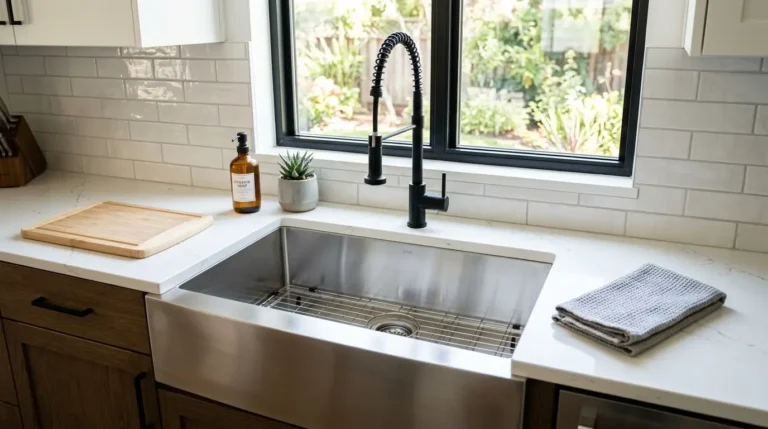
A well-kept sink can make even a small rental kitchen feel cleaner and more polished. Explore simple ways to keep your sink fresh and looking its best without expensive products or complicated maintenance.
11. Declutter Regularly to Make Every Solution Work Better

Every no-drill storage solution in this article works significantly better in a kitchen that contains only what belongs there, and no amount of clever no-drill organisation compensates for a volume of kitchen items that genuinely exceeds what any small kitchen can store well.
The renter’s storage challenge is partly a constraint problem, insufficient storage infrastructure in the rented kitchen, and partly a volume problem, more kitchen items than the available space can accommodate regardless of how well it is organised. The solutions in this article address the constraint problem effectively. Decluttering addresses the volume problem.
A kitchen where every stored item is used at least occasionally, where nothing is being stored out of habit or because disposing of it feels wasteful, is a kitchen that the no-drill solutions in this article can organise genuinely well. A kitchen full of infrequently used appliances, duplicate utensils, and items that belong in a different room of the apartment is a kitchen that no storage solution makes truly functional regardless of how clever.
A decluttering session of thirty to forty-five minutes, evaluating each stored item against the criterion of genuine regular use, produces a kitchen where the available storage space comes much closer to matching the storage need, and where the no-drill additions described above can make the remaining gap genuinely manageable.
Smart storage can do more than free up counter space it can change how spacious your entire kitchen feels. Explore simple design tricks that make a small kitchen feel bigger and discover ways to create a more open, airy look.
12. Create Zones That Make Every Item Findable

Zoning a small rented kitchen, assigning each category of item to a specific defined area of the kitchen and maintaining that assignment consistently, produces a kitchen that functions far above its storage capacity because nothing is ever searched for and nothing ever ends up in a location that is not its home.
A zoned kitchen has a cooking zone adjacent to the stove that holds oils, frequently used spices, and cooking utensils. A preparation zone near the primary counter holds cutting boards, knives, and prep tools. A breakfast zone holds cereals, toaster, and morning items together. A baking zone, even in a small kitchen, holds all baking supplies and tools in one accessible location rather than distributed across multiple cabinets.
The zone principle makes every storage addition in this article more effective because each addition has a specific function within a specific zone rather than being a general storage expansion that items fill without organisation. A tension rod lid organiser in the cookware cabinet serves the cookware zone. Command hooks on the inside of the breakfast cabinet door serve the breakfast zone. Each addition is purposeful rather than incidental.
Maintaining the zoning system is simply returning each item to its zone after use rather than to the nearest available space. This habit, once established, requires no effort beyond the moment of return and produces a kitchen that stays organised without any ongoing attention beyond that single action.
The Rented Kitchen That Works As Well As Any Other
The constraint of not being able to drill holes or make permanent modifications to a rented kitchen is a real constraint, but it is not the overwhelming limitation that it first appears. The solutions in this article collectively address every category of small kitchen storage problem through no-damage means, and they do so with products and approaches that are genuinely effective rather than merely compromise solutions.
A rented kitchen organised with the solutions in this article functions as well as, and in some cases better than, a comparable kitchen where drilling is permitted, because these solutions have been chosen specifically for their functionality and because the constraint of reversibility has actually forced more creative and more considered choices.
The kitchen that belongs to your landlord and the cooking life that belongs to you are both best served by a storage system that is genuinely functional, genuinely damage-free, and designed around how you actually cook rather than around the storage infrastructure the landlord happened to install.
Good storage habits can make a small kitchen much easier to keep looking tidy. Explore the simple habits that help a kitchen always look clean and discover practical ways to keep clutter under control.
FAQs About No-Drill Kitchen Storage for Renters
Command strips and hooks, when applied correctly to smooth, cleanly prepared surfaces and removed following the manufacturer’s stretch-to-remove instructions, leave surfaces undamaged. The critical steps are cleaning the surface with isopropyl alcohol before application, waiting the full cure time before loading, staying below the weight limit, and pulling the tab straight down slowly when removing rather than pulling outward.
With only two cabinets, the priority is maximising the interior of each cabinet with shelf risers and vertical dividers, maximising every cabinet door interior with over-door organisers, adding freestanding storage furniture, using the refrigerator top and side for magnetic and basket storage, and addressing counter organisation with trays and a strict clutter-free discipline.
Yes, provided the furniture is chosen to be genuinely portable and multi-purpose so that it moves with you and serves the next space as well as the current one. A rolling kitchen cart, narrow shelving unit, or butcher block island that is bought for a rented apartment is likely to be used across multiple rentals and potentially into a owned home, which makes the investment cost-effective over time.
Suction cup hooks work on smooth, non-porous surfaces including tile and glass but are considerably less reliable than Command hooks on painted surfaces and cannot support meaningful weight on any surface. They are appropriate for very lightweight items in wet areas like the inside of the sink, where adhesive products are less suitable, but should not be relied upon for general kitchen storage.
A kitchen without drawers needs a freestanding utensil organiser on the counter or a magnetic utensil bar on the refrigerator side for cooking tools, an over-door organiser or in-cabinet tension rod for utensil hanging inside a cabinet, and a portable stackable container system for the small items that normally live in drawers. The complete absence of drawers requires a combination of counter, door interior, and freestanding solutions rather than any single approach.
Cabinet liner paper, available in adhesive-free peel-and-stick formats that rest on the shelf without permanent adhesive, covers sticky or stained interior cabinet surfaces cleanly and provides a fresh working surface. The liner can be cut to size and removed when you leave without any damage to the cabinet interior, and it provides both a clean surface and a degree of cushioning for stored items.
Genuinely damage-free solutions such as over-door organisers, tension rods, freestanding furniture, and correctly applied removable Command products typically require no landlord notification because they leave no trace. If you have any uncertainty about whether a specific product is genuinely damage-free for your specific wall or surface type, testing it in an inconspicuous location first is a sensible precaution before applying it to a prominent surface.