
30 Farmhouse Kitchen Ideas and Decor Inspiration for Every Home
By Amelia Harper | Kitchen and Home Design Writer
The farmhouse kitchen is one of those design styles that has outlasted every trend cycle that has come along to challenge it, and the reason is not nostalgia. It is that the farmhouse kitchen reflects something genuinely true about how people want their kitchens to feel: functional, warm, honest about its materials, and designed for real cooking rather than for display.
It is a style built on the same principles that made working farm kitchens beautiful without trying to be, and those principles do not date.
What has changed in the contemporary interpretation of the farmhouse kitchen is the range of ways those principles can be expressed. The all-white shaker cabinet farmhouse kitchen of the early 2010s is one interpretation.
The dark-painted, unlacquered brass, reclaimed wood interpretation is another. The relaxed Mediterranean farmhouse and the spare Scandinavian farmhouse and the Southern American farmhouse with open shelving and collected ceramics are others still. All of them belong to the same tradition and none of them look identical.
I have been writing about kitchen design for nearly a decade, and the farmhouse kitchen remains one of the most requested and most genuinely rewarding design contexts to work in.
Farmhouse kitchens look best when every design element works together, including the floor beneath your feet. Explore beautiful flooring options for a farmhouse kitchen to find styles that add warmth, character, and durability to the space.
Here are thirty ideas and inspiration points that together cover the full range of what a farmhouse kitchen can be.
1. Start with a Farmhouse or Apron-Front Sink

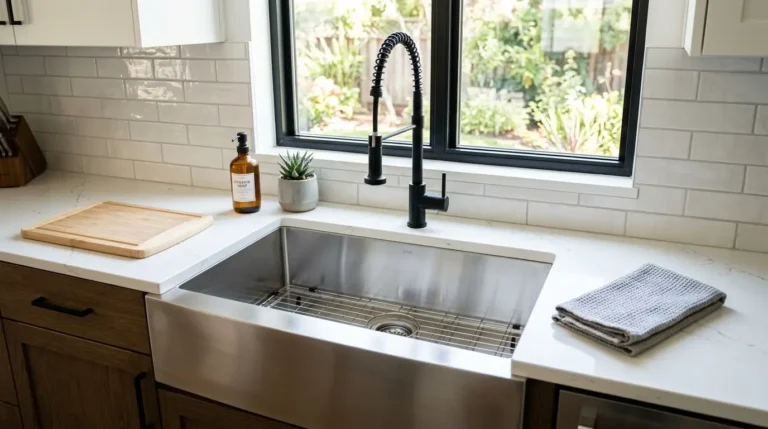
The farmhouse sink, also called an apron-front sink, is the single most identifiable element of a farmhouse kitchen and the piece that most immediately establishes the aesthetic register of the entire room.
A farmhouse sink is characterised by its front face, which extends forward to the edge of the countertop and is exposed rather than concealed behind a cabinet door. This exposed front, typically in white fireclay, stainless steel, or copper, has been the defining feature of working kitchen sinks since the era when sinks were plumbed with a single cold tap and built into thick stone or timber countertop surrounds.
The fireclay farmhouse sink in glazed white is the most classic choice and the one that anchors a farmhouse kitchen most definitively. The porcelain enamel surface is durable, stain-resistant, and ages beautifully rather than simply wearing. A single large basin is more practical for the farmhouse kitchen than a divided basin because it accommodates large pots and baking sheets that a divided sink cannot.
2. Choose Shaker Cabinet Doors

Shaker cabinets are the quintessential farmhouse kitchen cabinet, and their continued popularity in contemporary kitchen design across multiple decades is evidence of their genuine quality rather than fashion staying power.
The shaker door is defined by its flat central panel framed by a rectangular border. It is a design of total simplicity that draws attention to the quality of the wood and the craftsmanship of the joinery rather than to decorative elements. This honest material quality is the foundational principle of Shaker design and the reason shaker cabinets fit the farmhouse aesthetic so naturally.
Painted shaker cabinets in white, cream, or soft colour are appropriate for the farmhouse kitchen in any colourway. The paint quality matters significantly. A high-build eggshell or satin finish provides the depth and slight sheen that reads as quality rather than the flat finish that reads as economy.
3. Use Open Shelving for a Collected, Curated Look

Open shelving above the counter or in place of upper cabinets is one of the most characteristically farmhouse design choices available and one that produces one of the highest visual impacts when executed well.
Farmhouse kitchens historically used open dressers and shelving for dish storage because enclosed cabinet making was expensive and open storage was practical for daily use. The display of everyday ceramics, glassware, and stored ingredients on open shelves continues this tradition and creates the sense of a kitchen that is genuinely used rather than simply maintained.
The key to open shelving that looks beautiful rather than cluttered is curation rather than quantity. Each shelf should have enough breathing room between items that each piece reads individually. Grouping items by material or colour creates visual coherence without requiring a matched set.
Cabinet color can instantly shape the warmth and personality of a farmhouse kitchen. Explore timeless cabinet shades for a cozy farmhouse look to find colors that complement wood accents, natural textures, and rustic details.
4. Install Shiplap Walls or Cladding

Shiplap wall cladding, made from horizontal boards with overlapping edges that create a shadow line between each board, is one of the most distinctive wall treatments in the farmhouse aesthetic and one that brings immediate textural warmth to any kitchen surface it covers.
Traditionally shiplap was an exterior cladding material used for barns and agricultural outbuildings, and its appearance in farmhouse kitchen interiors references this agricultural origin while bringing a quality of material honesty that painted drywall cannot replicate. The shadow lines between boards at regular intervals create a horizontal visual rhythm that draws the eye across the wall rather than holding it at any single point.
Painted white or cream, shiplap reads as traditional American farmhouse. In natural pine with a clear oil finish, it reads as a warmer, more Scandinavian farmhouse. In a grey or sage tone, it reads as a contemporary farmhouse with more design self-consciousness.
5. Add Exposed Wooden Beams

Ceiling beams are one of the architectural elements most strongly associated with farmhouse interiors, and their presence in a kitchen immediately establishes the aesthetic’s characteristic combination of structural honesty and warmth.
In homes with genuine exposed timber frame construction, the beams are part of the building’s structure and need only to be cleaned and finished appropriately. In homes where ceiling beams are installed decoratively, the choice of beam material and profile is a design decision with significant visual consequences.
Solid reclaimed timber beams have the most authentic character and the most visual depth. New solid timber beams can be aged through wire brushing and oil finishing. Hollow decorative beam shells that slip over a structural timber or are applied to a drywall ceiling are the least expensive option and, when well-proportioned and correctly finished, can be convincing.
6. Embrace a Neutral and Earthy Colour Palette

The farmhouse kitchen colour palette is grounded in the natural and the earthly, drawing from the tones of undyed linen, aged wood, bare stone, fired clay, and whitewashed plaster rather than from the more saturated colours of urban or contemporary aesthetics.
White, cream, warm grey, sage green, dusty blue, terracotta, ochre, and raw umber are the colours that appear most consistently across all variants of the farmhouse kitchen aesthetic. These are the colours that remain present when fashion colours fade, which is why farmhouse kitchens built in different decades often look more similar to each other than kitchens in other styles built in the same year.
A palette of three tones, a dominant neutral, a secondary accent colour, and a natural material tone from wood or stone, is the structure that most farmhouse kitchen palettes follow. This limited structure prevents the visual complexity that would undermine the sense of relaxed simplicity the style depends on.
Even a charming farmhouse kitchen needs smart storage to stay functional and clutter-free. Explore space-saving storage solutions for small kitchens to make better use of cabinets, counters, and unused corners without sacrificing style.
7. Choose a Butler’s Pantry or Larder Cupboard

A butler’s pantry or larder cupboard, a dedicated enclosed storage zone separate from the main cooking and preparation area, is one of the most characteristically farmhouse kitchen elements and one that adds significant practical and visual value.
Historically the butler’s pantry was the room adjacent to the dining room where china, silver, and glass were stored and cleaned. The larder was the food storage room maintained at cool temperature for perishable provisions. In contemporary farmhouse kitchens, these functions are combined into a large freestanding cupboard or a dedicated pantry alcove within the kitchen itself.
A tall freestanding linen cupboard repurposed as a pantry, with its interior shelves lined with ceramic jars and baskets, is one of the most effective ways to introduce this element into a kitchen that was not designed with a butler’s pantry built in.
8. Install a Range or Range-Style Cooker

A range cooker, whether a traditional Aga or Rayburn, a modern range in the Aga tradition, or a large freestanding range with six burners and a double oven, is the cooking equipment most identified with the farmhouse kitchen and the element that most directly communicates the aesthetic’s commitment to serious cooking.
A cast iron range oven such as an Aga or equivalent represents the farmhouse kitchen at its most traditional, with a machine that heats the kitchen, dries wet clothes on its rail, and cooks everything from bread to slow braises without requiring active temperature management. The culture of cooking with a range oven is deeply embedded in farmhouse kitchen tradition across Britain, Scandinavia, and parts of continental Europe.
A contemporary range-style cooker in cream, racing green, or matte black brings the visual statement of the range without the specific cooking culture of the traditional solid fuel or oil-fired variety, and is the practical choice for kitchens where controllable heat and conventional cooking methods are priorities.
9. Use a Butcher Block Countertop or Island

A butcher block countertop, made from edge-grain or end-grain hardwood, is the natural surface companion to a farmhouse kitchen and one that brings a warmth and material quality that stone and composite countertops cannot match in this specific aesthetic context.
End-grain butcher block, where the cutting surface is the cross-section of the wood rather than the face grain, is the most durable format for a working kitchen surface and the format used in professional butcher blocks. The circular grain pattern visible on the surface is visually distinctive and becomes more characterful with use as the knife marks and oil applications build up over years.
Walnut, maple, and white oak are the most common hardwood species for kitchen butcher block, each with a distinctive grain and tone that suits different farmhouse kitchen colour schemes. Maintained with regular mineral oil applications, a quality butcher block countertop improves in appearance with age rather than wearing.
Farmhouse style comes alive through the little touches that make the space feel warm and thoughtfully designed. Discover the small kitchen details that leave a lasting impression on guests and add extra character to your farmhouse kitchen.
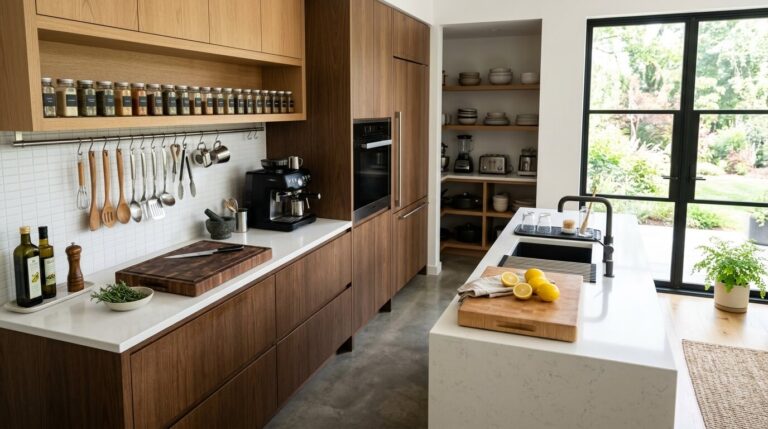
10. Hang a Pot Rack From the Ceiling or Wall

A hanging pot rack is one of the most functional and most visually characteristic elements of a farmhouse kitchen, and it performs the dual function of storing frequently used cookware accessibly and creating a visual layer in the kitchen that reads as genuinely functional rather than decorative.
Cast iron pans, copper pots, stainless pans, and colanders hanging from a ceiling-mounted pot rack at the appropriate height above the cooking surface are immediately accessible during cooking and create the kitchen-as-working-room quality that distinguishes a farmhouse kitchen from a display kitchen. The rack itself, whether a simple iron rail or an elaborate oval rack with hooks, contributes its own character to the space.
Wall-mounted pot racks on a backsplash or an open wall beside the stove are an alternative for kitchens where ceiling height or structural constraints prevent ceiling mounting. A set of simple iron hooks on a horizontal timber rail is the most straightforward and most honest version of this element.
11. Incorporate a Kitchen Island with Seating

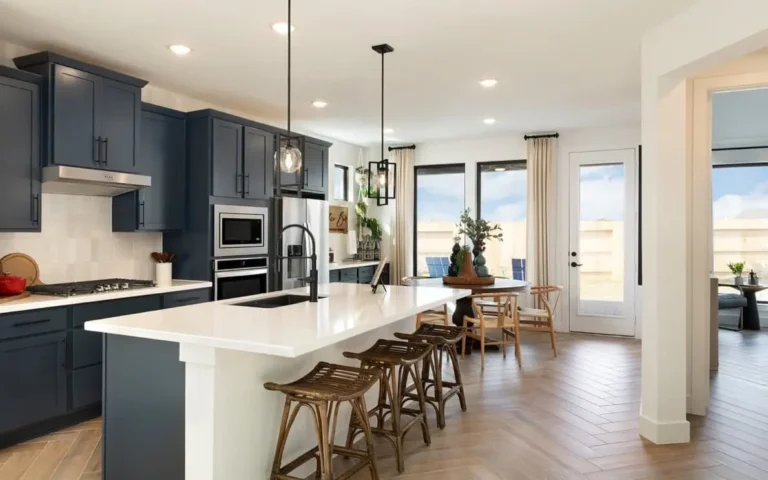
A kitchen island in a farmhouse kitchen serves as the social centre of the room, a gathering point for conversation during cooking and an informal dining surface that continues the farmhouse kitchen’s traditional function as the most-used room in the house.
The farmhouse kitchen island differs from the contemporary minimalist island in its character and its materiality. A butcher block top, painted legs in a complementing cabinet colour, and a lower shelf for basket storage are all more characteristic of the farmhouse aesthetic than a solid stone slab on concealed cabinetry.
Bar stools in natural rattan, turned wood, or simple iron with a wooden seat are the most appropriate seating companions to a farmhouse island. These materials reference the same natural and craft traditions that inform the farmhouse aesthetic overall.
12. Use Vintage and Antique Light Fixtures

Lighting in a farmhouse kitchen should reference the pre-electrical tradition of functional illumination, and the fixtures that do this most effectively are those with the quality of early electrical and pre-electrical domestic lighting: filament bulbs in industrial cages, enamel pendants, lantern pendants in iron or brass, and oversized glass globes.
An enamel schoolhouse pendant, the type that was used in American schools and industrial buildings from the late nineteenth century through the mid-twentieth, is one of the most versatile farmhouse kitchen pendant choices because it combines the industrial heritage, the practical shade function, and the visual simplicity that the farmhouse aesthetic values.
Pendants over a kitchen island should be hung at a height that allows comfortable conversation across the island while providing adequate task lighting for the work surface below. The general rule is approximately thirty inches above the countertop surface, adjusted for the ceiling height and the scale of the pendant.
Farmhouse countertops should feel warm, practical, and naturally inviting. Explore beautiful countertop ideas to find simple ways to make your kitchen surfaces fit the farmhouse style while staying functional.
13. Add a Barn Door as a Functional Detail

A barn door, sliding on an exposed track rather than swinging on hinges, is one of the most recognisable farmhouse architectural details and one that adds both function and character in kitchens where a swinging door would create problems with the room’s traffic flow.
The sliding barn door maximises the usable floor area in a kitchen by eliminating the arc of a swinging door and allowing the space to extend fully to the wall. In small kitchens where a pantry, larder, or passage is accessed from the main kitchen space, a barn door makes the transition between spaces smoother and more visual interesting than a conventional door.
The door itself can be made from reclaimed timber boards, painted shiplap, or glass-panelled wood, each producing a different balance between privacy and visual connection. A heavily planked reclaimed timber barn door at the farmhouse kitchen entrance is one of the most dramatic first impressions available in this aesthetic.
14. Display Ceramics and Pottery Deliberately

The farmhouse kitchen has always been a space where useful objects were displayed openly, and ceramics and pottery are the objects that most naturally belong in this context because they combine the functional, the artisanal, and the beautiful in proportions that are fundamentally farmhouse in character.
A collection of stoneware mixing bowls in graduated sizes stacked on an open shelf, a set of handmade ceramic mugs on hooks below a floating shelf, and a collection of lidded crocks for dry goods storage displayed on the counter or dresser are all examples of ceramics used in the farmhouse kitchen tradition of making the useful beautiful.
The ceramics that best suit the farmhouse kitchen aesthetic are those made by hand or made to look as though they might have been, with slight variations in glaze and form that reveal the human element of their making. Perfectly uniform commercial ceramics lack the character that farmhouse interiors thrive on.
15. Install a Classic Tile Backsplash

A ceramic tile backsplash in white or cream, installed in a simple subway or brick bond pattern, is one of the most enduring farmhouse kitchen details and one that has been present in domestic kitchens since ceramic tile became affordable in the early twentieth century.
The classic three by six inch subway tile, installed in a horizontal brick bond pattern, is the farmhouse kitchen backsplash standard. Its longevity comes from the combination of visual simplicity, material genuineness, and the practical cleanability that makes it appropriate for the surface immediately behind the cooking area.
A variation with interest is the installation of subway tiles in a vertical stack bond rather than horizontal brick bond, which produces a more graphic quality. A dark grout with white tiles produces a grid pattern that reads as more graphic and more contemporary than a matching white grout.
You don’t need a full renovation to give a farmhouse kitchen a fresh new feel. Explore small kitchen updates that can add character, improve functionality, and make the space feel more inviting.
16. Mix Old and New Elements Deliberately

The farmhouse kitchen that looks most authentic and most alive is almost never one that has been designed as a complete set from a single source. It is one where new elements are mixed with genuinely old or antique pieces in proportions that prevent any single era from dominating.
A new shaker cabinet installation paired with an antique kitchen dresser, a contemporary range cooker set into a period chimney breast, or a modern faucet on an antique farmhouse sink are all examples of the old-new mix that gives farmhouse kitchens their sense of accumulated character rather than designed uniformity.
The proportion of old to new is a matter of personal comfort and available sources. Even a single antique piece, a vintage meat grinder on a shelf, an antique ceramic storage jar on the counter, or a nineteenth-century kitchen clock on the wall, introduces the quality of age that purchased new interiors cannot replicate.
17. Use Wicker and Rattan for Storage and Texture

Wicker and rattan baskets, whether on open shelves, in cabinet interiors visible through glass doors, or on the lower shelf of a kitchen island, introduce a texture and material quality that reinforces the natural, handmade character of the farmhouse aesthetic.
A row of identically sized wicker baskets on an open shelf, each labelled for its contents, is one of the most characteristic and practical farmhouse kitchen storage solutions, combining the visual warmth of natural material with the organisational clarity of a defined system. The labels, whether handwritten chalk labels or printed kraft paper tags, add another layer of honest, low-technology detail.
Natural sea grass, water hyacinth, jute, and rattan all suit the farmhouse kitchen context and each has a slightly different texture and tone that contributes differently to the overall palette. Natural coloured baskets are the most versatile. Painted or lacquered baskets add less to the farmhouse character.
18. Incorporate a Chalkboard Wall or Panel

A chalkboard wall or painted panel in the farmhouse kitchen serves the functional purpose of a message board, grocery list surface, and recipe reference while simultaneously adding a characterful detail that references the schoolroom and the Victorian domestic tradition.
Chalkboard paint applied to a wall or panel creates a matt, slightly textured surface that accepts chalk and wipes clean, can be repainted when needed, and does not require any permanent installation beyond the painting itself. A panel framed in simple timber moulding applied to a kitchen wall creates a more finished chalkboard that reads as a considered element rather than a painted area.
The placement of the chalkboard panel matters. A position near the kitchen entrance, near the pantry, or near the cooking area, where lists and references are most useful, makes the functional aspect as strong as the decorative one.
19. Choose Unlacquered Brass Hardware

Hardware, specifically the door pulls, knobs, and hinges on cabinets and the faucet at the sink, contributes a material warmth to the farmhouse kitchen that painted and stainless steel finishes cannot provide, and unlacquered brass is the hardware finish that most consistently delivers this warmth across the broadest range of farmhouse kitchen colour schemes.
Unlacquered brass is brass that has not been coated with a protective lacquer, which means it develops a natural patina through contact with skin oils, air, and humidity over time.
This patina, a gradual shift from the bright gold of new brass through the warm honey tones of partially aged brass to the dark, slightly greenish tones of fully aged brass, is one of the most beautiful natural processes in domestic hardware and is the quality most associated with antique farmhouse fittings.
Bin pulls, cup pulls, and simple round knobs in unlacquered brass are the most classically farmhouse hardware choices. Bridge faucets and pillar faucets in brass are the appropriate sink companions.
20. Layer Rugs and Textiles for Warmth

The farmhouse kitchen differs from a commercial or purely functional kitchen in its use of textiles as warming elements, and the inclusion of a kitchen runner rug, layered linen curtains, and coordinated dish towels and cloth napkins is part of what gives farmhouse kitchens their characteristic sense of warmth and habitability.
A flat-woven or low-pile kitchen runner in natural wool, cotton, or jute in front of the sink, the stove, or along the kitchen island softens the hard floor surface underfoot, reduces the acoustic hardness of a tiled or stone kitchen, and introduces a pattern element that adds visual interest without competing with the other design elements.
Linen, cotton, and natural material textiles are the most appropriate choices for farmhouse kitchen textiles. Synthetic fabrics, even those that mimic natural textures, lack the quality of aging and washing that natural fabrics develop over time.
21. Install a Pot Filler Over the Stove

A pot filler, the articulated faucet mounted on the wall above the range and extended to fill pots directly on the stove without carrying them from the sink, is a farmhouse kitchen detail that combines genuine functional utility with a visual reference to the commercial and institutional kitchen fittings that farmhouse kitchen design has always drawn from.
The pot filler is not a purely decorative element but one that earns its installation cost for any kitchen where large pots of water are regularly boiled for pasta, stocks, preserving, and similar tasks. The reduction in physical effort from eliminating the carrying of heavy filled pots from the sink to the stove is meaningful over a lifetime of cooking.
A traditional pot filler in a simple bridge style, in brass or chrome, is the most classically farmhouse choice. A contemporary pot filler in matte black or stainless steel reads as a more modern interpretation of the same functional reference.
Even a cozy farmhouse kitchen can feel surprisingly spacious with the right design choices. Discover ways to make your kitchen feel bigger and learn simple tricks for creating a more open and airy atmosphere.
22. Display Vintage Kitchenware as Decoration

Vintage kitchen equipment, including old copper moulds, antique scales, vintage tin canisters, and early twentieth-century kitchen tools, contributes a layer of collected history to the farmhouse kitchen that contemporary reproductions cannot replicate because the patina and wear of genuine vintage objects is a record of actual use.
Copper jelly moulds displayed on an open shelf or hung from hooks on a dresser rail are one of the most classically farmhouse kitchen displays, combining the warm tone of aged copper with the graphic quality of the mould forms, which were designed to produce beautiful shapes in the finished preparations they shaped. Old scales with balance arms and a set of iron weights are another archetypal farmhouse kitchen object that is both genuinely useful and visually rich.
The authenticity of vintage objects matters in the farmhouse kitchen because the style’s credibility depends on material honesty. Reproduction vintage objects and decorative props that are designed to look old without having been used are less convincing companions in an interior that values genuine character.
23. Create a Built-In Banquette Dining Corner

A built-in banquette dining corner, where bench seating is built into an alcove or corner of the kitchen, creates the informal dining zone that is one of the most appealing features of the traditional farmhouse kitchen layout.
The farmhouse kitchen was historically the room where all family meals were eaten outside of formal occasions, and the integrated dining element was as important to its function as the cooking equipment itself. A built-in banquette reproduces this quality of dedicated eating space within the kitchen that a separate table and chairs arrangement suggests but does not quite achieve.
Bench cushions in natural linen, stripe cotton, or botanical print fabric are the most appropriate upholstery for a farmhouse banquette. A plank-top table in the same wood species as any other wooden elements in the kitchen creates material consistency.
24. Use Vertical Panelling or Wainscoting

Vertical wall panelling or wainscoting on the lower portion of the kitchen walls, typically to chair-rail height at around thirty-six inches from the floor, introduces an architectural detail that gives the kitchen a quality of considered finish and historical reference that plain walls cannot provide.
Traditional wainscoting uses recessed panel moulding applied to a plywood or MDF base that is then painted to create the shadow and depth of a panelled wall. In the farmhouse kitchen context, the simplest flat panel wainscoting in a shaker tradition is more appropriate than the elaborate raised and fielded panel profiles associated with more formal architectural periods.
Painted in the same colour as the lower kitchen cabinets, wainscoting creates a visual band of colour that grounds the kitchen without the wainscoting reading as a separate element from the cabinetry. Painted in a contrasting colour, it becomes a more defined design detail.
25. Incorporate a Butler’s Sink with a Traditional Tap

A Butler’s sink, which is the British term for what Americans call a farmhouse sink, paired with a traditional tap set in the pillar or bridge style rather than a modern mixer, is the classic farmhouse kitchen sink combination that has been present in British farmhouse and country house kitchens for over a century.
The pillar tap, with separate hot and cold taps rather than a single mixing lever, is the most historically accurate choice for a traditional farmhouse kitchen and the one that reads most consistently with a period-influenced interior. In practical terms, the contemporary equivalent of the pillar tap is the bridge mixer, which maintains the visual character of separate tap pillars while providing the single-handle temperature control that modern plumbing makes practical.
Cross-head or lever handles in the same finish as other brass hardware in the kitchen maintain material consistency across the sink area.
26. Add a Herb Garden in the Kitchen Window

A kitchen window herb garden, planted in terracotta pots, enamel jugs, or simple ceramic planters on the windowsill or on a shelf directly in front of a window, is one of the most characteristic farmhouse kitchen details and one that serves a genuine daily function.
Fresh herbs in the cooking kitchen connect the interior to the growing world outside it, reinforce the farmhouse kitchen’s relationship to food provenance, and provide a fragrance that contributes to the quality of the kitchen’s atmosphere alongside its visual character. Basil, rosemary, thyme, chives, mint, and parsley are the most useful and most suited to indoor kitchen growing.
Terracotta pots are the most classically appropriate containers for a farmhouse kitchen herb garden because the material is genuinely associated with kitchen growing across centuries of domestic gardening. A drainage saucer under each pot prevents water damage to the windowsill.
27. Install Beadboard Backsplash or Cabinet Inserts

Beadboard, the cladding made from narrow vertical planks with a rounded bead at each joint, is a traditional American farmhouse and Victorian domestic material that brings a textured, cottage-style quality to any kitchen surface it covers.
As a backsplash material painted in white or cream, beadboard creates a visual rhythm of vertical lines that draws the eye upward and adds a textural warmth that tile does not provide. Its practical limitation as a backsplash is that the joints between planks require careful painting to seal against moisture, and the surface is less easy to clean than a glazed tile surface in the area immediately behind the cooking surface.
As inserts in the recessed panels of shaker cabinet doors, beadboard creates a variation on the plain shaker that is more textural and more cottage-like in character. This variation is particularly effective on island cabinet doors and on the lower cabinets of a farmhouse kitchen where the texture is at a comfortable viewing height.
28. Use Marble or Stone for a Baking Station

A marble or natural stone surface dedicated to pastry and baking within the farmhouse kitchen is both a highly practical element and a characterful one that references the dedicated pastry marble that was a feature of well-equipped country house kitchens.
Marble is particularly valued for pastry work because its thermal mass keeps it naturally cool, which is the ideal surface temperature for handling butter-based pastry doughs that would soften and become difficult to handle on a warm surface. A marble slab inset into a wooden countertop, or a marble-topped section of the kitchen island, creates the dedicated baking surface without replacing the butcher block or stone of the main counter.
White or grey marble with subtle grey veining is the most visually compatible choice for a farmhouse kitchen baking station. The marble should be sealed before use to prevent staining from food preparation.
29. Layer Lighting for Farmhouse Warmth

Farmhouse kitchen lighting should create warmth rather than uniform brightness, and achieving this requires layered sources rather than a single overhead fixture.
Pendant lighting over the island or dining area provides the ambient glow that defines the kitchen’s atmosphere. Under-cabinet lighting provides the task illumination that practical cooking requires. A wall-mounted lantern or sconce near the sink or the range adds a point of warm light that references the oil lamp and gas lamp tradition of the historical farmhouse kitchen.
Warm-toned bulbs in the 2700 to 3000 Kelvin range produce the amber-tinted light that creates the warmth associated with farmhouse interiors. Cool white bulbs in the 4000 Kelvin range produce a flatter, more clinical light that works against the warmth the farmhouse aesthetic depends on.
A farmhouse kitchen should be beautiful, but it also needs practical tools that make everyday cooking easier. Explore useful kitchen essentials that fit naturally into a cozy farmhouse space while helping you cook faster and more comfortably.
30. Keep the Farmhouse Kitchen Genuinely Lived In

The final and most important farmhouse kitchen idea is not a design element but a philosophy: the farmhouse kitchen should look and feel genuinely used rather than maintained for appearance.
A cookbook left open on the counter. A jug of garden flowers that are a day or two old. A basket of vegetables from the most recent shopping trip. A kettle with scale on its base that shows daily use. These are the details that distinguish a farmhouse kitchen that is genuinely lived in from one that has been styled for photography and then preserved unchanged.
The farmhouse aesthetic is fundamentally about the beauty of a working space, and working spaces accumulate the marks of use. Embracing rather than concealing these marks of daily life is the approach that produces the farmhouse kitchens that people remember and want to return to.
The Kitchen That Feels Like Home
Every farmhouse kitchen idea in this article connects to the same underlying quality: a kitchen that feels like a place where life genuinely happens, where food is grown and stored and prepared and shared, where the materials are honest and the arrangement reflects how the space is actually used rather than how it might look in an ideal state.
This quality is not achieved by purchasing the right elements from a design catalogue. It is achieved by making choices that reflect genuine values about food, craftsmanship, material honesty, and the pleasure of a well-used kitchen. The farmhouse aesthetic provides the design language for expressing those values. The kitchen you build with it becomes yours.
FAQs About Farmhouse Kitchen Design
No. The farmhouse aesthetic works in small kitchens through careful material selection, open shelving, and a few well-chosen characteristic elements rather than through scale.
Farmhouse kitchens lean toward the functional and the honest material, with agricultural references. Cottagecore kitchens are more romantic and floral, with more decorative pattern and garden imagery.
Yes. A modern farmhouse kitchen uses clean lines and a restrained palette while retaining characteristic elements like a farmhouse sink, shaker cabinets, and natural materials.
Butcher block, marble, soapstone, and concrete are all appropriate farmhouse countertop materials. Butcher block is the most classically associated with the style.
No. A range-style cooker achieves the visual statement without the cooking culture commitment. Any cooker works in a farmhouse kitchen when the surrounding elements establish the aesthetic.
Terracotta tile, reclaimed wood, flagstone, slate, and encaustic patterned tile all suit the farmhouse kitchen. Wide plank wood in natural or aged finishes is one of the most popular contemporary choices.
Open shelving, removable shiplap panels, ceramic displays, textile additions, lighting changes, and a countertop butcher block board are all renter-appropriate farmhouse elements.
White, cream, sage green, dusty blue, warm grey, terracotta, and ochre are the most consistently appropriate farmhouse kitchen colours. Natural wood tones provide warmth alongside any of them.