
Why Your Lawn Still Looks Messy After Mowing?
By Amelia Harper | Kitchen, Lawn Care and Outdoor Living Writer | Updated July 2026
You just finished mowing. The grass is cut, the mower is put away, and you walk to the end of the driveway expecting to feel that particular satisfaction that comes from a freshly mowed lawn. Instead, something still looks off.
The yard looks ragged, or patchy, or dull, or just generally less impressive than you expected given the hour you just spent out there. You are not imagining it. A freshly mowed lawn can still look messy for a whole range of reasons, and most of them have nothing to do with the mower itself.
Sometimes the problem isn’t your mowing technique it’s the equipment you’re using. Explore our guide to the best battery-powered lawn mowers and find a model that delivers a cleaner, more even cut.
I have been writing about lawn care for nearly a decade, and this is one of the questions I get more than almost any other. The answer is rarely simple and almost never just one thing. Lawn appearance after mowing is the result of several factors working together or against each other, and understanding those factors is what allows you to actually fix the problem rather than just mowing again and hoping for a different result.
Here is everything that can cause a lawn to still look messy after mowing, and what each of those causes means in practical terms for your yard.
1. Your Mower Blade Is Dull

This is the single most common cause of a messy-looking lawn after mowing, and it is the one that most homeowners overlook for far too long.
A sharp mower blade cuts grass cleanly, slicing through each blade in a single clean motion. The cut tip is precise and the grass blade heals quickly. A dull blade does not cut so much as it tears. Instead of a clean slice, you get a ragged, shredded tip on each grass blade, and those torn tips turn brown within a day or two of mowing. From a distance, a lawn full of torn, browning grass tips looks dull, yellowish, and generally unhealthy rather than fresh and green.
The test is simple. After mowing, take a close look at the tips of the grass blades in your yard. If they look clean and even, the blade is doing its job. If the tips appear frayed, shredded, or tattered, the blade is tearing rather than cutting, and it needs to be sharpened or replaced.
For most homeowners mowing a standard residential lawn, blades should be sharpened at least once per season. If you mow every week through a long growing season, you may need to sharpen mid-season as well. Sharpening is inexpensive and the single highest-return maintenance task you can perform on a mower.
2. You Are Cutting Too Much at Once

There is a widely recognised principle in lawn care called the one-third rule: you should never remove more than one-third of the grass blade’s height in a single mowing session. Cutting more than this stresses the grass significantly, exposing the lower portions of the plant that are typically paler, weaker, and more vulnerable than the upper growth. The result is a lawn that looks scalped, uneven, and stressed rather than crisply trimmed.
When you go away for a week and come home to grass that has grown to five or six inches, the temptation is to set the mower at its lowest height and cut everything back to two inches in one pass. This is precisely the wrong approach. The better option is to cut it to four inches, wait a few days, and then cut again to your target height. It takes an extra session but the visual and health outcome is dramatically better.
Scalping is particularly visible in hot, dry conditions when the lower exposed portions of the grass cannot recover quickly. The lawn can look almost scorched in patches where the mower has cut too deep, especially if those areas were already slightly higher than the rest due to uneven growth.
3. You Are Mowing at the Wrong Height

Every grass variety has an optimal mowing height range, and mowing below that range consistently produces a lawn that looks stressed, thin, and generally unkempt rather than manicured. Bermuda grass, for example, thrives when kept between half an inch and one and a half inches tall. Tall fescue looks best at two and a half to four inches. Kentucky bluegrass does well between two and three and a half inches. St. Augustine performs best between two and a half and four inches.
Cutting below these ranges does not make the grass look more manicured. It actually weakens the grass plant by reducing its ability to photosynthesise, which leads to thinner turf, increased vulnerability to drought and heat, and a generally washed-out appearance. The lawn looks sparse and worn rather than dense and green.
If you are not sure what type of grass you have, take a photo and look it up or contact your local cooperative extension office. They can identify your turf type and provide specific mowing height recommendations for your climate and region.
4. Your Lawn Has Uneven Terrain

Even the most precisely adjusted mower and the sharpest blade produce inconsistent results on uneven ground. Dips and bumps mean the mower deck rises and falls as it travels, cutting some sections shorter than others and in some cases scalping high spots while barely touching low spots. The result is visible height variation across the lawn surface, which reads as patchiness from any distance.
Lawn terrain becomes uneven over time through a combination of factors: soil settling, burrowing animals, foot traffic patterns creating compaction in some areas, freeze and thaw cycles pushing the soil surface up and down, and tree roots growing closer to the surface. None of these happen overnight, which is why a lawn that looked flat several years ago can develop meaningful terrain variation over a season or two.
Addressing uneven terrain requires topdressing, the practice of applying a thin layer of topsoil or compost over low spots and working it in with the existing turf so the grass grows up through it gradually. This is not an overnight fix. It typically takes several applications over one or two seasons to significantly level an uneven lawn, but the visual improvement in mowing results even after the first application is usually meaningful.
5. You Have Thatch Buildup

Thatch is the layer of dead and living organic material, primarily decomposing grass stems, roots, and debris, that accumulates between the soil surface and the living grass blades above. A thin layer of thatch, up to about half an inch, is actually beneficial for a lawn because it moderates soil temperature and moisture. But when thatch accumulates beyond half an inch, it creates problems that directly affect how a lawn looks after mowing.
A heavy thatch layer acts like a sponge. Mower wheels sink into it unevenly, causing the cutting deck to rise and fall just as it does on uneven terrain. The result is an inconsistent cut height across the lawn. Additionally, thick thatch prevents water, air, and nutrients from reaching the soil effectively, which stresses the grass above it and causes thin, yellowing patches that are visible after mowing.
You can check your thatch depth by removing a small plug of turf and measuring the spongy layer between the grass roots and the soil surface. If it is more than half an inch thick, dethatching is overdue. This can be done with a thatching rake for small lawns or a power dethatcher for larger ones. After dethatching, the lawn often looks worse temporarily before it recovers over the following weeks with improved nutrient and water access to the roots.
6. Clippings Are Being Left in Clumps

Grass clippings left uniformly across a freshly mowed lawn are beneficial. They decompose quickly and return nutrients to the soil, essentially functioning as a light fertiliser application. This is the purpose of mulching mowing, and done correctly it is genuinely good for turf health.
The problem occurs when clippings are deposited in clumps rather than distributed evenly. This happens most often when the grass is very long before mowing, when the grass is wet, when the mowing speed is too fast for the conditions, or when the mower deck is clogged with debris. Clumps of clippings sitting on the lawn surface block sunlight from the grass beneath, can promote fungal growth in wet conditions, and look visually untidy from any angle.
If you are consistently dealing with clumping, the solutions depend on the cause. For wet grass, waiting until the lawn is dry before mowing is always the better approach, both for cutting quality and for clipping distribution.
For long grass, slowing your mowing speed or making two passes at different heights allows the mower to process a more manageable volume of material per pass. For a clogged deck, cleaning it before and after each session dramatically improves airflow and discharge.
7. You Are Mowing Wet Grass

Mowing wet grass is one of those things that feels harmless in the moment and reveals its problems in the hours and days that follow. Wet grass blades bend and lay flat rather than standing upright to be cut evenly.
The mower cuts some blades and passes over others entirely, leaving an irregular cut height that becomes visible as the grass dries and returns to an upright position. What felt like a thorough mowing session often reveals missed patches and uneven sections once the grass dries.
Beyond the visual inconsistency, wet grass clumps more readily, as mentioned above. It also compacts the soil more significantly under the weight of the mower, particularly on heavier or clay-based soils, and it creates ruts more easily on soft ground. Repeatedly mowing wet grass gradually damages the soil structure in ways that affect long-term lawn health.
The straightforward rule is to wait until the grass surface is dry before mowing. This does not mean waiting for the soil to dry completely, just the grass blades themselves. Morning dew typically clears by mid-morning on a sunny day. After rain, waiting until the afternoon of the following day is usually sufficient for the grass surface to be dry enough for a clean mow.
8. Your Lawn Has Weeds Mixed In

Weeds do not behave the same way as turf grass under a mower. Different weeds grow at different rates, have different stem structures, and respond to mowing differently. Some weeds, like dandelions and plantain, grow close to the ground with rosette-shaped leaves that largely escape the blade entirely. Others, like crabgrass and clover, grow in spreading patches at a lower height than the surrounding turf, creating visible irregularity in the cut surface.
After mowing, a lawn with significant weed content often looks patchy because the areas of grass and the areas of weeds reflect light differently, have different textures, and respond to the cut at different heights. Even with a perfectly maintained mower and good technique, a weedy lawn will not look uniform after mowing because the material you are mowing is fundamentally non-uniform.
The long-term solution to weed issues is a combination of proper turf density, appropriate fertilisation, correct mowing height, and targeted weed control. A thick, healthy lawn crowds out most weeds naturally. Sparse or stressed turf creates the bare patches and weak growth that weeds exploit most effectively.
Addressing the underlying cause of thinness, whether that is compaction, poor drainage, shade, or nutrient deficiency, is more effective over time than chasing weeds in a lawn that cannot outcompete them.
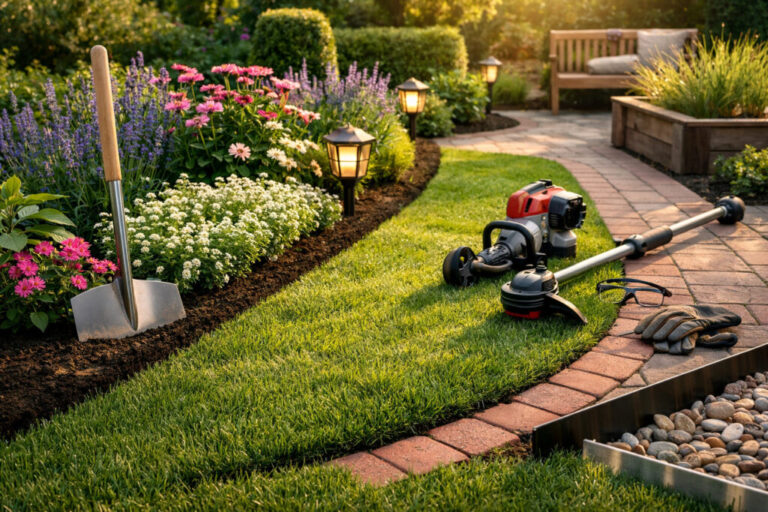
9. The Lawn Lacks Defined Edges

This is not technically a mowing problem, but it is one of the most significant contributors to why a mowed lawn looks unfinished. The edges of your lawn, where the grass meets the sidewalk, the driveway, the garden beds, and the fence line, act as a visual frame for the entire yard.
When that frame is clean and defined, the eye perceives the whole lawn as well-maintained even if the mowing itself is imperfect. When the edges are ragged, overgrown, or undefined, the eye perceives the whole lawn as untidy even when the mowing is technically correct.
Grass grows outward continuously at the edges, and a mower alone rarely handles this growth cleanly. The result, without regular edging, is grass encroaching gradually onto hardscapes, softening and eventually eliminating the visual boundary between the lawn and the path or bed beside it.
Edging once a week during the peak growing season, and once every two weeks during slower growth periods, maintains the frame that makes all your other mowing effort actually visible. The difference in perceived lawn quality between a well-mowed lawn with clean edges and the same mowing job without edging is substantial and immediate.
10. Your Mowing Pattern Is Working Against You

The direction and pattern in which you mow affects how the lawn looks, particularly on longer-grass lawns and on varieties that respond visibly to directional cutting. Mowing in the same direction every single week causes the grass to lean in that direction over time, creating a dull, flat appearance as the blades all reflect light from the same angle rather than standing upright.
Alternating your mowing direction with each session encourages grass to grow more upright, which produces a more uniform appearance and better reflects light evenly across the surface. If you went north to south last week, go east to west this week, or at a diagonal. The alternating pattern also reduces the soil compaction that forms in wheel tracks when the mower always travels the same path.
For those who enjoy the striped look seen on professional sports fields and well-tended private lawns, stripes are created by bending grass blades alternately in opposite directions. A roller attachment on the rear of the mower, or a dedicated striping kit, creates the bent-blade effect that produces visible light and dark stripes depending on the viewing angle.
This is a visual technique rather than a functional one, but understanding it explains why some lawns look so dramatically different from others despite receiving similar mowing frequency and care.
11. The Grass Is Under Stress

A stressed lawn does not respond to mowing the same way a healthy one does. Drought stress, heat stress, nutrient deficiency, disease, and pest damage all affect the colour, density, and structure of the grass in ways that are not resolved by mowing and that become more visible immediately after a cut removes the upper growth.
Yellow or pale grass often indicates nitrogen deficiency or drought stress. Thin, sparse turf suggests compaction, poor soil health, or shade stress. Brown patches with distinct margins can indicate fungal disease.
Irregular yellow or brown patches with no clear pattern may indicate grub damage below the surface. Mowing reveals all of these issues more clearly because it removes the visual buffer of longer growth and exposes the lawn surface as it actually exists.
Addressing stress requires diagnosing the specific cause first. A soil test, available through most cooperative extension offices for a minimal fee, tells you your soil’s nutrient levels and pH, both of which affect grass health directly. Core aeration in the spring or autumn improves compaction.
Adjusting irrigation frequency and timing addresses drought stress. Identifying and treating fungal disease or pest damage requires appropriate treatment for the specific problem identified.
12. Seasonal Changes Are Affecting Appearance

Lawns look different at different points in the growing season, and some of that variation is completely normal rather than the result of anything you are doing wrong. Cool-season grasses like Kentucky bluegrass and fescue look lush and green in spring and autumn and go through a period of slower, more stressed growth during the peak heat of summer.
Warm-season grasses like Bermuda and Zoysia thrive through summer heat and go dormant and brown in cool months.
Transitional zones where both types are present can look genuinely inconsistent through parts of the year as different grass types in the same lawn are at different stages simultaneously. After mowing, this inconsistency is more visible than when longer growth blends the differences.
Understanding your grass type and its seasonal behaviour helps you set realistic expectations for how the lawn will look at different times of year, and helps you make appropriate adjustments to mowing height, frequency, and care routine for each season rather than applying the same approach year-round and wondering why the results vary.
Even a well-mowed lawn can look untidy if the edges are uneven. Discover how to achieve cleaner lawn edges with simple techniques that give your yard a crisp, professional finish.
Bringing It All Together
The messy post-mowing lawn is almost always the result of several of these factors overlapping rather than just one. A sharp blade improves everything immediately. Correct mowing height matched to your grass type, consistent edging, and addressing underlying issues like thatch, compaction, and weeds improve the results over time.
The most effective approach is to start with the basics and work through them systematically. Sharpen or replace the blade. Check your mowing height against your grass type. Edge the lawn after mowing. Then look at what remains and work from there. In most cases, the improvement from the first two steps alone is significant enough to feel immediately encouraging.
A lawn that looks good after mowing is not the result of special equipment or unusual effort. It is the result of consistent habits applied correctly over time. Most of the factors in this article are simple to address once you know what to look for.